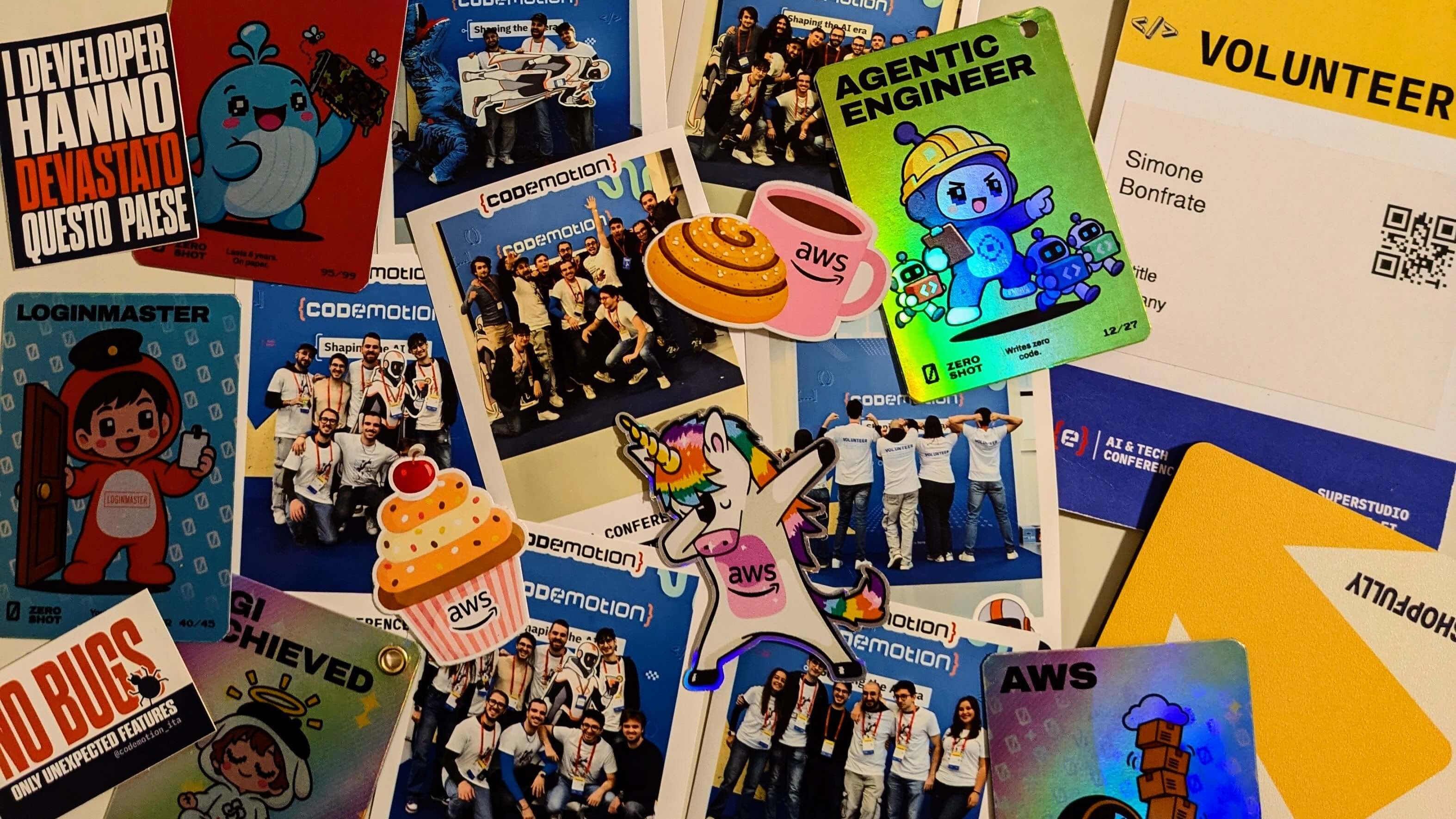
I want to share my first Codemotion experience as a volunteer. It was a huge opportunity I caught by contacting Michela, an old colleague from my time at GDG Bari as Community Lead. Without considering community-maintained events such as DevFest, I had only joined the WeAreDevelopers Conference @ Berlin and Google I/O Connect @ Amsterdam and Berlin (first three editions) as a regular attendee, and I was curious to try a big Italian conference while also helping with the logistics, which added a bit of spice. Muy caliente! I helped for two days by supporting the MCs, which allowed me to listen to my track’s talks and try to extract a direction from what our Italian programming society; bigger than communities supported by single actors such as Google and AWS, is discussing through the talks.
[Topics] You already know what it is, but there are small gems
Yes, of course, the discussion was about AI and Agents, but it went further by focusing on practical problems identified during everyday work: from specific technical mechanisms for increasing GPU usage to how a team can scale without going into burnout and while reducing manager bottlenecks. I also appreciated some open-source projects, such as Maurizio Argoneto’s, which shows a multi-agent architecture to analyze the codebase and discover if library vulnerabilities expose your application to attacker exploits. One topic I started to appreciate was about solutions that generate a lot of simulations to test your decisions and evaluate them through a multi-agent system that retrieves lessons, generates simulations, evaluates, and teaches you how to be a better developer, manager, or person depending on which books you use as retrievable content. Then, there was the talk about how a team with a single Product Manager and multiple Product Engineers each focus on a specific customer problem, reducing cognitive load. A product engineer is more focused on a specific product domain and the whole technology stack, assisted by AI. The current approach, where engineers are focused on one technology but manage multiple product domains, introduces context-switching problems and cognitive load in managing the task, the artifacts produced by agents, and the final deliverable. In addition, the old approach centralizes decisions in the PM only, who becomes the bottleneck.
But there were also non-AI-related talks: the first was about a new Kubernetes in-place pod resize, which allows reducing CPU and memory resources without restarting the pod, thanks to Linux cgroup v2. This feature allows giving the pod more resources for bootstrapping and reducing them when the service is running. Another interesting talk was about simulating the Italian parliament as a Git repository, with a lot of limits regarding temporal queries, which could be managed through a different service while relying on Git only for textual storage.
[Direction] What I breathed from my piece of reality
By talking with a devoted attendee (he has attended since the first edition 13 years ago!), I learned that Codemotion is continuously growing and is starting to leave some pieces behind to transform into a conference for seniors and technology experts, by presenting talks on architectures, use cases, and team management. There are fewer talks on a specific technology or a single feature, because now AI can write the whole service, letting you manage only the work, like a product manager. It is like when a senior only manages architectures and people without touching the code: people start to miss coding and creating their own projects, even though they weren’t the next Redis, because it was satisfying and at the end you learned something.
I hope this kind of topic can be inherited by community conferences and meetups, because talks about the new version of a library or a new pattern for writing better code continue to be an absolute pillar for being a good developer assisted by AI, and not a non-technical “cuggino” with a Lovable subscription because he needs a lot of credits to fix simple vibecoded shit.
[Gadget Time] Which sponsor/partner wins the best gadget of the conference?
And this conference was also conquered by trading cards. Yeee! With the trading cards trend, I found two groups that use their cards to foster engagement between attendees: the first is Bizzynow, which has developed a playing game like Magic, which now, instead of character roles, features speakers. At Codemotion, they also organized a tournament. Second, but no less fun, was Zero Shot, a collecting game where you have to talk with other participants in order to achieve points or new installations. These make it easy to start talking with other people if you want.
Stickers weren’t missing either; all sponsors had theirs, especially Codemotion itself. They made just 6 sticker types, but I have so many I can distribute them when I go to talk somewhere. I appreciated the stickers from Google and ShopFully for their style and humor. An honorable mention goes to SUSE, whose hat was very cool. Meanwhile, I loved the OpenAPI keycap keychain and the Poste Italiane Pikachu stamp keychain so much. But the best gadget was from AWS: it provided a nice combination of cool stickers and a coffee thermos that is very well made.
[Opinion] What do I think, overall, about this experience?
To put everything in a nutshell, I appreciated the experience. The quality of the presented talks was very high, from what I had the chance to listen to during my speaker support. I also had the chance to be an MC too, even if just for one talk. It was so exciting and the “performance” was good. The organization was very good because our volunteer teams had a master figure (thanks Vale!) who orchestrated us, which made the interface between us and the organizers much easier. Probably, I’ll also join next year’s Rome edition to have the chance to return to that beautiful city.
Comments
Sign in with GitHub to leave a comment or reaction. View discussions on GitHub.